Tuesday, June 5, 2012

Foraging in Crow’s Backyard

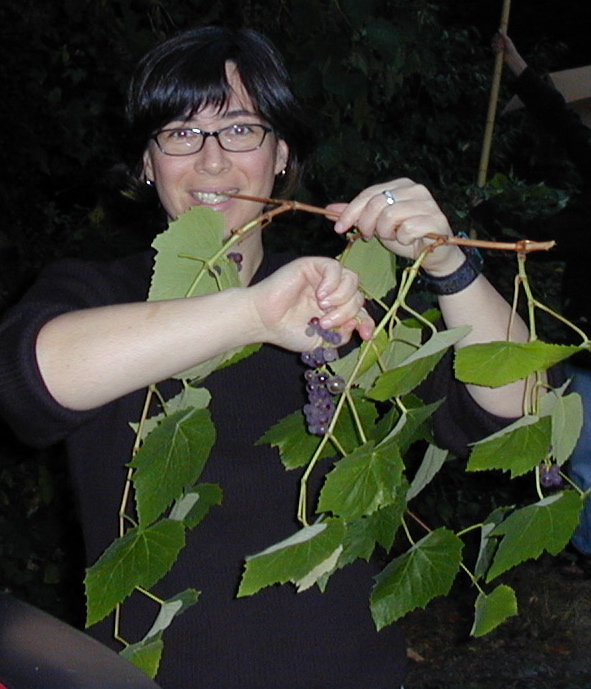
The fermenting smell of Concord grape takes me back to one of my earliest childhood memories. The wild grape vine on the property line between our home and the neighbors’ opened doors to the adventure and abundance of late summer in Northern California. I remember walking around the block, visiting with neighbors, and gleaning fruits such as plums, pomegranates, lowquats and crabapples, and exploring the morphology of acorns and walnuts that had fallen to the ground, never quite figuring out how to process them for their promise of nutmeats. I come from a family of sporadic foragers, shellfish harvesters, and dumpster divers. Many of us doIn fact, it may be a very long line of foragers and hunters.

a feral & hearty 50+ year old grape vine behind our house on Beacon Hill, Seattle WA

To my child’s mind, it made little sense for food to waste on trees, or on the ground for that matter. Foraging was a way to explore my environment and engage a sense of wonder. It still is. Edible plants like wild mint and lemony sorrel offer the adventurous tastes of nature. Reclaiming wild, neglected and discarded food is my family ethic; and I hope it might also once again become a wider species ethic.

Perhaps more subversive than simply diverting edibles from the wasteshed back into the foodshed, however, I’m interested in foraging as a way to more deeply embed ourselves in the environments where nearly 80% of Americans now live: cities. What’s so subversive about urban foraging? First, it pushes us to consider that anthropogenic landscapes (such as cities) are also natural landscapes where wildness thrives. Second, it challenges tired narratives about modernization and human evolution that make ongoing subsistence invisible.

This is where the idea of Crow’s Backyard comes into greater perspective. Crows are emblematic of this wildness and our interconnectedness with urban nature. The habitat perhaps most closely associated with this native corvid species is the urban habitat. Crows are birds of the city. They’re adaptive, inventive, and resilient. In her book Crow Planet: Essential Wisdom from the Urban Wilderness, Seattle naturalist Lyanda Haupt writes (p. 13):
Crows remind us that we make our homes not in a vacuum, but in a zoƶpolis, a place where human and wild geographies meet and mingle.
The idea that modern post-industrial cities are devoid of wildness, and furthermore that people who live in cities are disconnected from nature, may well be based on a myth that allows us to ignore the intricate dimensions of wildness in cities, and the ways in which human dwellers engage with plants, mushrooms and diverse urban habitats through the gathering, tending and consumption of wild foods. 
Any landscape marked by human intrusion is, in ecological parlance, disturbed, and as a habitat-type, the urban landscape can only be called highly disturbed. The word disturbe has a Latin root, turbare, which means “to agitate” or “to confuse,” “to pour together,” “to mix utterly.” How fitting! Wild and domestic. Native and introduced. Rare and invasive. Pavement and pathway. Human and wild. The extraordinary and the commonplace. (Crow Planet, Haupt, p. 177)
Urban foraging forces us to reconcile with another myth: that the lifeways of so-called hunter-gatherers were either long ago sealed in some cave, or else relegated to isolated human populations who have yet to evolve into modern “homo economicus” –the hominid species who supposedly gave up inefficient and suboptimal foraging for the convenience and cheapness of agroindustrial food. What I know from my family experience, and confirmed in greater detail and complexity through my work as an anthropologist and ethnoecologist, is that foraging is an ongoing and thriving contemporary practice that brings great meaning to people, connecting them with their homelands –whether urban or remote– and to one another.

borderlines of industry & healing plants 

Gathering wild foods, medicines and craft material in “Crow’s Backyard” connects people to the wildness of the urban landscapes in ways that bring us more fully into nature. Urban foraging deepens our relationships with plants and ecosystems in the city. In doing so, it breaks down the false dualisms that separate humans from nature, and nature from cities. 
All living things together. All eating, breathing, drinking, spawning their seed, raising their young, leaping, crawling, questioning, thriving, just ever so barely getting by. No wonder most of us are mystified about our proper relationship to wild life, when our substrate itself is so thoroughly confounded. No wonder we are unprepared for this remarkable banquet. No wonder we close our eyes, toss birdseed, and hope for the best. (Crow Planet, Haupt, p. 177)
Like crows, people are adaptive, creative and resilient. And the nature in cities, where many of us make our homes, offers a tasty, nutritious, and in some places abundant, wild buffet.

from wasteshed to foodshed


Wednesday, May 2, 2012

Urban Harvest: a multimedia science story produced by University of Oregon journalism students

A collaboration with the Science Stories journalism class at the University of Oregon. They produced a  a multimedia series on science stories in the Pacific Northwest. Here is the clip they put together about our Urban Foraging study.


Thursday, September 22, 2011

Sharing the Magic of Black Cottonwood Bud Salve

One of my favorite things about foraging and wildcrafting is the culture of sharing that exists between practitioners. Foragers often share their bounty, wildcrafted goods, knowledge and friendship. This past winter, a new foraging friend shared her knowledge and techniques for harvesting and making Black Cottonwood Bud Salve (aka “Balm of Gilead”).


photo credit: Joyce
Black Cottonwood (Populus balsamifera ssp trichocarpa) is a native broadleaf tree that grows in the wet regions of the Western Washington lowlands (including Seattle). The tall tree with its furrowed bark and a yellowish hue is a member of the willow family (Salicaceae), and like other poplars, contains resins and cambium with medicinal, food and material uses. When processed as a salve, cottonwood can be used to relieve pain and is known for its antimicrobial, anti-inflammatory and antioxidant properties. Honeybees also use derivatives (propolis) from poplar trees to protect their hives.

The best time to gather Black Cottonwood buds is December to February when leaf buds are beginning to form. Gathering in the winter is a quiet and meditative pleasure and a great excuse to get outdoors for exercise and fresh air. The most recent winter solstice, I went to a few spots in Seattle where I know Cottonwood trees grow. A recent storm had littered the ground with windblown branches of plump leaf buds. I plucked off and collected about two pocketsful of buds from the fallen branches.

At home I processed the buds, wiping off bits of dirt and dried leaves, placing the resinous buds in a clear jar and bathing them in olive oil, covering the opening with a cloth to allow air circulation. I set the jar in a sunny window and let the oil slow-extract the resin from the buds for two months, stirring occasionally with a wooden chopstick. The air and the oils smelled like a delicious walk in the woods. 


After two months, I strained out the leaf buds, leaving the cottonwood infused oil.  To make the balm, I needed beeswax. I offered the cottonwood bud salve in exchange for some locally produced beeswax from Seattle’s beekeeper extraordinaire (Ballard Bee Co). I melted the wax and mixed in the resinous oils then poured the liquid salve into small jars.

Each jar of cottonwood bud salve contains within it the magic of winter poplar, the hard work of bees, and the generosity of a community of foragers who continue to pass down generations of medicinal plant knowledge.

Wednesday, September 21, 2011

Fungi Foraging in Seattle and Beyond

Seattle has a diverse mycota – or fungi community – linked to its mild climate and biologically diverse plant community. Of the many hundreds of species of fungi in Seattle, there are at least 40 known mushrooms with edible and medicinal properties and another handful used for fiber dying, artistic purposes, and ecological restoration. Safe harvesting and consumption of mushrooms requires expert knowledge and when done with care can be a rewarding and sustainable way to find foods and materials in our local urban environment.
Turkey Tail Necklace photo by Joyce 
The foraging that takes place within Seattle is primarily for personal use. Most of the folks who forage wild mushrooms have spent years learning the art of identification. Anyone interested in getting started should get involved with the Puget Sound Mycological Society (PSMS). PSMS offers identification classes and organizes mushroom forays for learning more about fungi ecology, identification, and related soil issues (which may render an otherwise edible mushroom unsafe for human consumption – a concern in urban areas with industrial land-uses). Knowing your mushrooms is essential and some edibles have poisonous look-a-likes. Among the choice edibles found in Seattle are: Leccinum scabrum (“birch bolete”); Agaricus agustus (“the prince”), Pleurotus ostreatus (“oyster mushroom”), and the occasional Morel.

While there are valuable mushrooms to be found in the urban ecosystems of Seattle, many mycophiles set their eyes towards the mountains where the abundance and variety may be greater. Prized edible mushrooms that can be found in the Cascade and Olympic Mountains (within a couple of hours from Seattle) include: Boletus edulis “King bolete”, a variety of morels and chanterelles, Tricholoma magnivelare “matsutake”, and Sparassis crispa “cauliflower mushroom” among many other edible species. Check with local jurisdictions about harvesting permits and regulations. The usual cautions around identification apply here as well.
With the proper skill set, mushrooming can be a safe, rewarding, and sustainable way to interact with our environment.
This post originally appeared on Urban Farm Hub, where Melissa Poe is a contributing writer.

Stinging nettle: a charismatic plant

Stinging nettle is a charismatic plant. While some people intently avoid it, others seek it out with passion. As noted by anthropologist Erna Gunther in 1927: “The medicinal value of this plant seems to be as great as its power of irritation.” Stinging nettle, Urtica dioica, is an herbaceous plant found growing widespread in moist lowland forests of the Pacific Northwest, including many of the urban forests of Seattle. There isn’t a consensus on whether it’s a “native” plant or “introduced”. Some people consider nettle to be an “invasive” plant, based on its sheer abundance and “nuisance” characteristics. The dispute over its status is emblematic of the love-hate relationship people have with nettle. Park managers and joggers express interest in removing the plant and mowing it down, while foragers are happy to help control its abundance through active harvesting. For foragers, nettle is one of the most prized wild greens in Seattle. Why?

Nettle is an important wild plant used for food, medicine, fiber and cordage. It’s long been an important plant for Native Coast Salish communities, and its utility is also enjoyed by diverse groups of urban residents. All parts of the plant are used: leaves, roots, stems, and seeds. It can be enjoyed as leafy green in culinary dishes or as a potherb, yielding high nutritional value (especially noted for its iron, protein and vitamin A & C, potassium, manganese and calcium.) Nettle tea can be made from the leaves, stems, and roots. It has many medicinal uses, including both oral and topical application for pain relief. The same parts of the plant can be crushed and used as a poultice –or for brave souls, applied directly– to painful areas. And the roots can be used as shampoo. The stems are used by many Coast Salish groups to make two-ply cordage and used as fishing nets and hunting snares.

Nettle heralds the wild bounty of the coming spring. The early shoots emerge in late January and tender young leaves are picked in subsequent harvests throughout late winter and Spring, and often a Fall harvest. Be on the look out for nettles beginning to sprout around local wildlands. Spring nettles are more tender and mild, with a green earthy flavor that some describe as similar to spinach. Although some foragers have refined techniques for harvesting nettles barehanded, most wear gloves to avoid being stung. The sting comes from tiny hairs on the leaves and stems that carry natural chemical that is an irritant to humans and other animals, leaving painful welts. Once steamed (or boiled) for five minutes or dried, nettles will not sting you. If you do get stung, and when it’s not intended to treat your arthritic pain, rubbing the exposed area of skin with nearby plant Yellow Dock (Rumex crispus – a useful plant in its own right) provides a readily available antidote. As does time: “just a day will do ‘ya.” Most harvesters use snippers to clip the tops of the plants, which may encourage plant vigor and growth for repeat harvesting in one season. Snipped tops go right into a bag. Foragers pay close attention to the locations of nettle patches and avoid areas that have exposure to toxins and heavy metals, such as roadsides and areas where herbicides may be used. Nettles grow on private and public lands. Publically-managed lands have different regulations about harvesting. Foragers may want to check with local jurisdictions about which laws apply.
This post originally appeared on Urban Farm Hub where Melissa Poe is a contributing author.